Precision optical coating
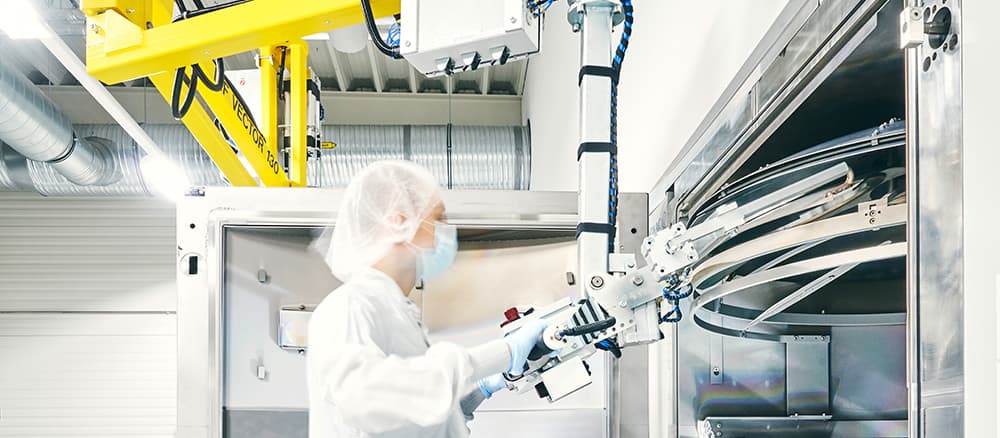
High-end optical coatings in the spectral range from UV to near infrared for demanding optical components with reasonable delivery times and reliable service - that's optical lens coating made by asphericon. Equipped with state-of-the-art manufacturing and measuring technologies available on the market as well as an experienced team of technicians, we turn your ideas into reality. Discover our types of optical coatings.
Optical coating technologies at asphericon
Looking for a customized optical coating for your application? asphericon's portfolio includes:
- Dielectric Anti-Reflection Coating,
- Dielectric mirrors,
- Metallic mirrors,
- Filter layers and
- Beam splitter
Depending on individual properties of the material and the requirements of the optical system, we select the appropriate coating technology for your project. For this purpose electron beam evaporation, ion beam assisted deposition or sputtering can be used.
Specifications optical coating
Standard coatings
| AR-Coatings | V-Coatings |
|---|---|
| A: RMAX <1.0%, RAVG ≤0.4%, 400-600 nm, AOI=0° | K: R < 0.25%, 355 nm, AOI=0° |
| B: RMAX <1.0%, RAVG ≤0.4%, 600-1050 nm, AOI=0° | L: R < 0.25%, 532 nm, AOI=0° |
| C: RMAX <1.0%, RAVG ≤0.4%, 1000-1500 nm, AOI=0° | M: R < 0.25%, 1064 nm, AOI=0° |
| X: RMAX <1.0%, RAVG ≤0.4%, 240-380 nm, AOI=0° | |
| Y: RMAX <1.0%, RAVG ≤0.4%, 320-450 nm, AOI=0° |
Customized optical coatings
| Electron Beam Evaporation | Ion Assisted Deposition | Magnetron Sputtering | |
|---|---|---|---|
| Substrate size (Diameter) | up to 300 mm | up to 300 mm | up to - 250 mm |
| Spectral range | 190 - 5100 nm | 190 - 5100 nm | 380 - 5100 nm |
| Stability | good | very good | ultra-hard |
| Residual reflection | Rabs < 0,1% (V-Coating) | Rabs < 0,1% (V-Coating) | Rabs < 0,1% (V-Coating) |
| Feature | - | usage of plasma source | sputter-up technology |
| Applications | AR | ARBB, HR | ARSBB, HR, Filter |
| Fast-Lane Service (24/48h) | optional | optional | optional |
The full spectrum of optical coatings at asphericon
Dielectric Anti-Reflection Coating
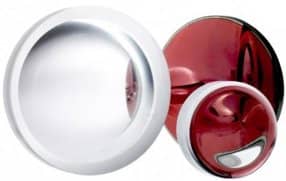
If too much light is reflected in a laser application, throughput is reduced and laser-induced damage can result. To increase the transmission of a system and reduce reflections, optical surfaces can be refined with anti-reflective coatings. Reflection-minimizing coatings, also referred to as anti-reflection coatings, are essential for maximum transmission of optics. Depending on the desired application, we offer single layer coatings, broadband coatings and reflection-minimizing coatings specific for laser applications. It is possible to minimize the reflection to <0.1%, depending on the glass type.
Download coating curves:
Super Broadband Coating (ARSBB)
Request Dielektrische Anti-Reflection coating
Dielectric mirrors
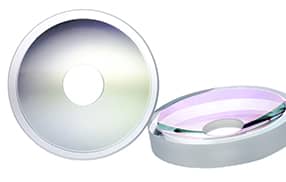
Dielectric coatings (also called thin-film or interference coatings) consist of thin layers of transparent dielectric materials. Optical interference between reflected or transmitted partial beams of incident light can be generated by dielectric coatings. This allows almost arbitrary adjustment of the light's transmission and reflection. Absorption-free, stress-minimized optical mirror coatings optimized for various angles of incidence with reflections greater than 99% can be produced for various wavelength ranges with dielectric coatings.
Mirrors can be specialized for single wavelengths (Single High Reflection, or SHR), two wavelengths (Double High Reflection, or DHR) and over a broad spectral range (Broadband High Reflection, or BBHR). Our high-power coatings are optimized for high-performance laser applications.
Download coating curve:
Single High Reflection (SHR) | Broadband High Reflection (BBHR)
Request Dielectric mirrors
Metallic mirrors
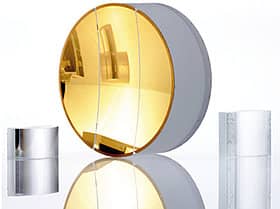
Metallic mirrors provide a constant level of reflection across a very wide wavelength range and are highly effective at reflecting light beams. The surfaces are based on metals (e.g. Al, Ag or Au). Metallic mirrors can be protected and their reflectivity enhanced by adding dielectric coatings.
Download coating curves:
High-Reflection Aluminium Mirror (ALENHM)
Request Metallic mirrors
Filter layers
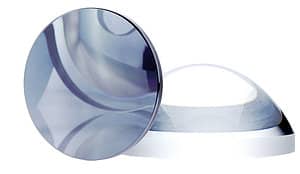
For many applications, various wavebands can be separated with filter coatings. We offer short pass and long pass filters based on dielectric coatings. Short pass filters allow short wavelengths to pass, while long wavelengths are reflected. In contrast, long pass filters transmit the long wavelengths and reflect the short wavelengths.
Download coating curves:
Request Filter layers
Beam splitter
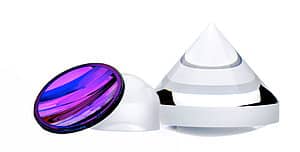
Beam splitter coatings divide incoming light into a transmitted and a reflected part. Based on thermally very stable dielectric layers, we realize customer-specific desired splitting ratios, typically 50 % / 50 % (R/T) or 30 % / 70 % (R/T).
Download coating curve:
Request Beam splitter
ITO coatings: electrical conductivity on optical surfaces
Indium tin oxide (ITO) is a conductive thin film that is also optically transparent. It enables electrical functionality on optical surfaces while maintaining high transmission and low reflection loss. asphericon manufactures ITO layers using ion beam-assisted deposition (IBAD).
Specifications
| ITO-Coating | |
|---|---|
| Film resistance | < 12 Ω/sq (customizable upon request) |
| Transmission | 97,5 % (450–750 nm) |
| Reflectance | < 0,5 % (450–750 nm) |
| Absorption | 2 - 3 % (with AR coating) |
| Substrate geometry | Flat and curved |
Development, manufacturing and qualification are performed in-house in Europe.
Typical applications include, for example:
- Transparent EMI shielding
- Optical heating functions (anti-fog, anti-icing)
- Display and OLED-Technologies
- Photovoltaics
- Conductive substrates for microfluidic or biological systems
Do you have specific requirements regarding layer resistance or substrate geometry? Talk to our team.
FAQ - ITO coatings
What does ITO stand for?
ITO stands for indium tin oxide, a transparent, electrically conductive oxide. When applied as a thin film, it combines high optical transmission with measurable electrical conductivity. This combination is virtually impossible to achieve with conventional optical coatings.
Why is ITO used on optical components?
In certain applications, a purely optically effective surface is not sufficient. The surface must also perform an electrical function. ITO coatings enable this without significantly impairing the performance of the optical component. Typical applications include electromagnetic interference (EMI) shielding as well as heating functions to protect against fogging or icing on optical surfaces.
What is EMI shielding?
EMI stands for electromagnetic interference. This refers to unwanted interference radiation that can impair the function of sensitive optical or electronic systems. EMI shielding refers to measures that shield against this radiation. A unique feature of optical surfaces is that such shielding must remain transparent at the same time so as not to impair optical function. ITO coatings meet precisely this requirement: electrically conductive enough to provide a shielding effect, yet highly transparent for the spectral range in use.
Can the sheet resistance and transmittance of ITO coatings be adjusted?
asphericon offers ITO coatings as standard with a sheet resistance of less than 12 Ω/sq and a transmittance of 97.5% in the 450 - 750 nm range. These two parameters are physically related: higher conductivity (lower sheet resistance) is generally accompanied by lower transmittance. Depending on the application requirements, application-specific adjustments are possible. Please contact us.
Request ITO-Coating
Optical coatings for UV, VIS and IR
FAQ - Optical Coatings
What types of optical coatings are there?
The main types of optical coatings include anti-reflection coatings (AR), high-reflection mirror coatings (HR), metallic mirrors, spectrally defined filters (e.g. short-pass, long-pass or bandpass filters), and beam splitter coatings. Depending on the application, they are designed as single-layer, multi-layer or broadband coatings, optimized for the desired spectral range, angle of incidence and required optical performance.
What are optical coatings used for?
Optical coatings are used in almost every field of photonics and optical metrology. Typical applications include high-power lasers, imaging, sensor technology, life sciences, medical technology, aerospace and semiconductor manufacturing. Optical coatings can, for example, improve the efficiency and stability of optical systems.
What materials are used for optical coatings?
Optical coatings are mainly produced using dielectric materials with high or low refractive indices, as well as metals such as aluminum, silver or gold. The choice of material determines properties such as reflection, transmission, absorption and laser resistance, and should be precisely matched to the requirements of the target application.
How do optical coatings improve the performance of optical components?
By precisely controlling reflection, transmission and absorption, optical coatings optimize the way light is guided through lenses, mirrors, prisms or filters. For example, they can reduce losses, increase efficiency, improve measurement precision, or protect optics from laser-induced damage. Optical coatings are a key factor in achieving durable, high-performance optical systems.
Which quality criteria are particularly important for optical coatings?
Relevant quality parameters include, for example, low residual reflection, precise layer thicknesses, refractive index stability, minimal absorption, low scatter losses, a high laser-induced damage threshold (LIDT), and resistance to environmental factors and temperature. These factors determine the reliability and performance of a coated optic.
What advantages do custom coatings offer?
Individually developed optical coatings offer maximum performance, as they are precisely matched to wavelength, angle of incidence, substrate material, laser power and environmental conditions. They enable the highest levels of transmission and reflection, improved stability, and optimal system efficiency.
How does the choice of material affect factors such as refractive index, absorption and blocking ranges?
The choice of coating material defines how light is reflected, transmitted or blocked. Metals provide broadband reflection, while dielectric materials enable precise interference effects, for example for steep filter edges, selective blocking ranges or highly reflective mirrors. Combining different materials allows for targeted optical designs.
What advantages do plasma-assisted or vacuum-based coating processes offer?
Modern processes such as sputtering produce dense, robust and long-term stable coatings. They ensure low absorption, high reproducibility and excellent laser resistance, even on sensitive substrates and in large production volumes.
In which industries and systems are optical coatings used?
Optical coatings are used in laser optics, medical technology, imaging, sensor technology, microscopy, spectroscopy, automation, the semiconductor industry, aerospace and consumer electronics. Wherever light needs to be precisely controlled, coatings are a decisive factor for performance and reliability.