
Precision Agriculture and Photonics
Technologies for the Future of Agriculture
Content
What is smart farming, and how can photonics help address agriculture’s key challenges?
Smart farming is a data-driven management approach that uses sensor data, imaging, and AI-based analysis to apply resources such as water, fertilizer, and pesticides precisely where and when they are needed.
Agriculture is facing one of the greatest challenges in its history. According to United Nations projections, the world’s population will grow to approximately 10.18 billion by 2100. With around 33 percent of the world’s soil already moderately to severely degraded, and arable land unable to expand fast enough to keep pace with population growth (source: SPECTARIS & Messe München, 2023), simply using more fertilizer and pesticides is not the answer. That approach reached its limits decades ago. Since at least the 1980s, gains in agricultural productivity have come less from increasing inputs than from managing existing resources more intelligently.
This is where smart farming comes in. It enables farmers to use resources more efficiently, optimize yields, and reduce environmental impacts simultaneously. To achieve this, one thing is essential: reliable, high-resolution, real-time data from the field.
How is precision farming structured, and what role does photonics play?
Precision farming is more than just attaching a sensor to a tractor. It is a management approach based on observing, measuring, and responding precisely to variability within and between fields. The technologies underpinning this approach can be divided into four areas: robotics and automation, imaging and sensor technology, digitalization and data analysis, and bioengineering[C.
Fig. 1: Photonics as the connecting element between the four segments of precision farming. All four are fundamentally dependent on photonic technologies.
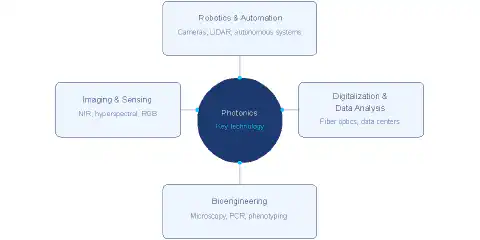
What these four segments have in common is that they all rely fundamentally on photonics. Robots need optical sensors to move autonomously and perceive their surroundings. Imaging systems are photonic by nature, because they detect light. Data networks run on fiber optics. Biological research, which develops new plant varieties and resistance traits, relies on microscopy, fluorescence techniques, and imaging-based analysis. In short, without photonics, there can be no smart farming.
Why is photonics a key technology in precision agriculture?
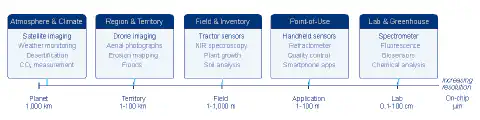
The strength of photonics lies in its versatility. It can capture information quickly, precisely, and without contact across scales ranging from molecular structures to satellite images. In precision agriculture, this means that a single family of technologies can be used for crop screening in the field, quality control at the processing plant, and weather monitoring from orbit.
Fig. 2: Photonic technologies cover every spatial observation scale, from planetary remote sensing to microscopic analysis on a chip.
Photonic methods are already being used in agriculture in a range of areas, including:
- Lighting in greenhouses and vertical farms: LED systems enable the light spectrum to be tailored to a plant’s specific needs, promoting growth without wasting energy.
- UV disinfection: Water and substrates can be disinfected using UV light. Recent studies also show that UV-C flashes can activate plants’ immune defenses and significantly reduce the need for chemical pesticides.
- Drone and satellite imaging: Hyperspectral and multispectral cameras capture aerial images of fields and provide spatially resolved data on plant health, moisture content, and nutrient supply.
- Field spectroscopy: Mobile and machine-mounted NIR sensors analyze soil, crops, and fertilizers in real time, eliminating the need for laboratory analysis.
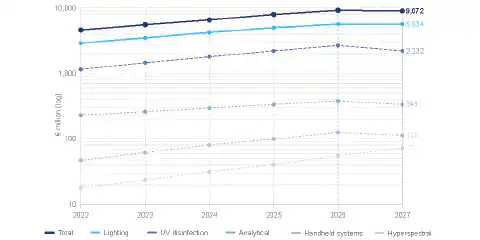
According to SPECTARIS, the global market for photonic technologies in precision agriculture was worth approximately €4.6 billion in 2022 and is projected to grow to more than €9 billion by 2027. This corresponds to an annual growth rate of about 15 percent and reflects the rapidly rising demand for technological solutions in this sector.
Fig. 3: Global market for photonic technologies in precision agriculture, 2022–27 (€ million, logarithmic scale). Source: SPECTARIS/Tematys, 2023.
What can plants reveal through fluorescence?
Fluorescence imaging is a particularly informative method within photonic sensing. The principle is simple: when excited by light of a specific wavelength, plants emit light in a pattern that is characteristic of their physiological state. This fluorescence signal provides insight into the condition of the photosynthetic apparatus and thus, indirectly, into stress responses, nutrient deficiencies, and the onset of disease - often long before they become visible to the human eye.
The technical challenge is clear: the fluorescence signal is weak—very weak. In the open field, it competes with the intense, broadband sunlight illuminating the plant at the same time. To extract a usable signal, fluorescence imaging requires optical systems that reliably suppress this spectral background while maximizing the number of relevant photons captured in the target wavelength range. This is engineering under real outdoor conditions, where every lens surface, every coating, and every air gap matters.
Fluorescence is just one of several photonic methods used in precision agriculture.
What photonic measurement methods are available, and what are they suitable for?
Photonics-based measurement methods provide far more than just images. Depending on the method, various plant parameters can be measured without contact, in real time, and without sampling:
- RGB imaging captures color, shape, and growth structure in the visible spectrum. It is suitable for detecting visible damage and growth abnormalities, but cannot detect changes that fall below the threshold of visibility.
- NIR spectroscopy (near-infrared) uses characteristic absorption patterns of organic molecules in the 800–2,500 nm range. Water content, as well as protein, starch and sugar content, can be determined directly in the crop. This method is already being used on harvesters in the field.
- Hyperspectral imaging expands RGB imaging by adding hundreds of spectral channels. The result is spatially resolved maps of chlorophyll content, nutrient distribution, or drought stress, which can be captured by drone, satellite, or stationary greenhouse systems.
- Fluorescence imaging captures the light emitted by the plant itself following optical excitation. The signal reflects the state of the photosynthetic apparatus and often responds more sensitively and earlier than any other optical method to stress, nutrient deficiency, or pathogen infection.
The table below compares photonic measurement methods in precision agriculture in terms of measurable parameters, typical applications, and deployment locations.
| Method | Measured parameters | Typical applications | Deployment locations |
|---|---|---|---|
| RGB imaging | Color, shape, growth structure, visible damage | Detection of growth abnormalities, discoloration, harvesting robots | Drone, tractor, greenhouse |
| NIR spectroscopy | Water content, protein, starch, sugar, dry matter | Crop quality analysis, fertilizer management, silage optimization | Harvester, handheld device, laboratory |
| Hyperspectral imaging | Chlorophyll, nutrient distribution, drought stress, pest infestation | Field mapping, early warning of plant diseases, phenotyping | Satellite, drone, greenhouse |
| Fluorescence imaging | Photosynthetic status, stress, pathogen infection, nutrient deficiency | Early disease detection, plant screening, breeding research | Field, laboratory, greenhouse |
| LiDAR | 3D structure, stand height, biomass, positioning | Autonomous machine control, crop surveying, terrain models | Tractor, drone, robot |
| UV imaging/UV-C | Microbiological contamination, surface disinfection, immune stimulation | Water disinfection, pesticide reduction, greenhouse hygiene | Greenhouse, processing |
In modern precision farming systems, these methods are increasingly being combined to obtain a comprehensive picture of plant health.
What is quantiFARM, and how is asphericon contributing to the project?
The collaborative quantiFARM project (full title: “Quantitative Optical Differential Diagnostics for Environmental Protection and Sustainability in Agriculture”) combines high-resolution photonic sensors with AI-based analysis directly in the field.
By screening soil and plants, the project aims to collect precise data on crop conditions, allowing farmers to tailor their use of water and fertilizer more closely to actual plant needs.
In the OptFlou subproject, which focuses on developing optical systems for fluorescence imaging cameras, asphericon is collaborating with JB Hyperspectral Devices and the Fraunhofer IST (Institute for Surface Engineering and Thin Films). asphericon’s contribution includes:
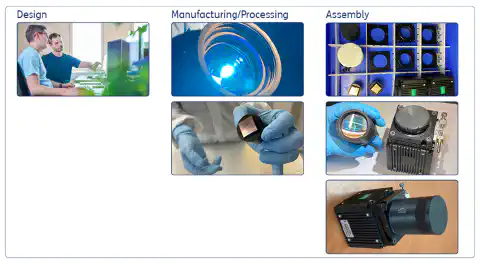
- Optical design, manufacture, and assembly of a five-element lens with a spatial resolution of 2 - 3 cm, fine enough to resolve individual leaves
- Development of a special lens coating that is anti-reflective only in the fluorescence-relevant wavelength range of 750 - 770 nm and reliably suppresses broadband sunlight, a first for asphericon’s coating production
- Fabrication and integration of a mosaic filter from the Fraunhofer IST
- Final assembly of all components under cleanroom conditions
Fig. 4: Steps in camera production, from optical design and engineering to production of the lens elements and mount components, processing of the mosaic filter, and final assembly.
The image data generated by the system is fed into an AI model that uses fluorescence patterns to draw conclusions about plant health.
Conclusion: Is smart farming the future of agriculture?
quantiFARM exemplifies a development that is still in its early stages in precision agriculture: the combination of high-resolution photonic sensors with AI-based data analysis directly in the field. The optical challenges involved - weak signals, strong background radiation, and harsh outdoor conditions - demand solutions that go far beyond standard components. From nanoscale anti-reflective coatings and micrometer-level cleanroom assembly to filter processing with arc-second precision, the path from a good idea to a field-ready instrument involves numerous highly precise development and manufacturing steps.
The appeal of such projects lies in saving on fertiliser, reducing crop losses by detecting plant diseases early on, and using agricultural resources more efficiently. Smart farming is not a distant vision. It is an engineering challenge. Precision agriculture requires precision optics and partners who understand both worlds.
Sources
d’Humières, B. (2023): Photonic Technologies for Agriculture. Berlin/Munich: SPECTARIS & Messe München GmbH
Statista Research Department: “Forecast of Global Population Growth Through 2100.” Statista, November 26, 2025. Accessed May 21, 2026. https://de.statista.com/statistik/daten/studie/1717/umfrage/prognose-zur-entwicklung-der-weltbevoelkerung/